
An Unusual Late-Summer Truce at Stearns
August 21, 2026
Bald Eagles and Red-tailed Hawks can be anything but friendly neighbors. Around active nests and dependent young, encounters between the two species can include persistent harassment, chasing, and aerial attacks. That makes what we observed at our Stearns Bald Eagle territory between August 11 and August 18, 2026, particularly interesting.
Sharing Nest C (Bald Eagle Nest Tree)
Nest C has an interesting history of its own. Red-tailed Hawks previously nested there before the Stearns Bald Eagles began using the nest. Although we have not located the Red-tailed Hawks’ current nest this year, they continue to use this part of the territory.
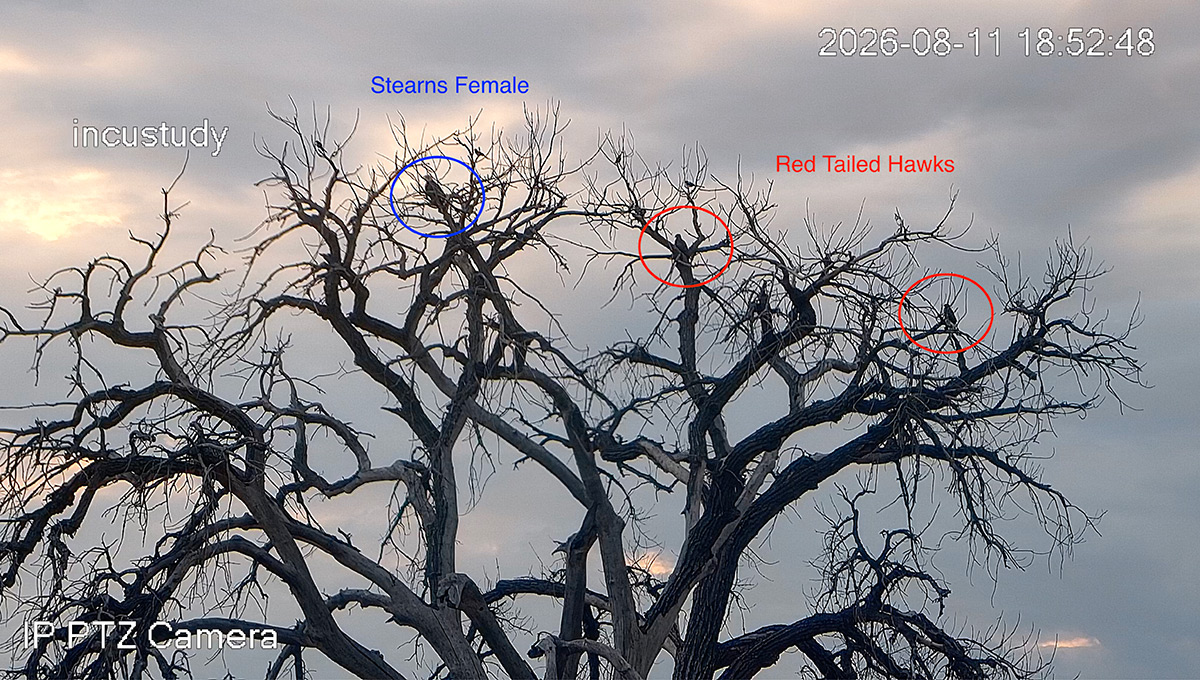
Stearns adult female Bald Eagle sharing the Nest C tree with two Red-tailed Hawks.
A week later, the association became even more remarkable.
Sharing the “Owl” Perch Tree
During the late afternoon and evening of August 18, multiple Red-tailed Hawks were moving between Nest C and a nearby perch tree we call “Owl,” approximately 100 m from Nest C. Both trees are familiar perches used by the eagles and Red-tailed Hawks.
At times, both adult Bald Eagles and multiple Red-tailed Hawks occupied the Owl perch tree simultaneously. The accompanying image documents both adult eagles and three Red-tailed Hawks—five large raptors sharing the same tree.
Across our observations from August 11–18, we documented as many as five Red-tailed Hawks gathered in this immediate Nest C/Owl area. We have positively identified at least two of them as juveniles of the year, and two others appear to be adults.
The timing and grouping are consistent with what we have observed during Red-tailed Hawk post-fledging dependence (PFD) in previous years, when juveniles and their parents congregate around familiar territory perches. Taken together, we think it is likely that we are seeing a local family group, including the paired adults and their dependent juveniles.
We have not located this pair’s 2026 nest, so we cannot confirm that relationship from the nest itself. However, given the repeated association of these birds, the presence of at least two confirmed juveniles, and the similarity to RTHA family behavior we have documented here during previous PFD periods, we think that is the most likely explanation.
What we could document with certainty was extraordinary proximity between the two species, and the seasonal context makes that particularly interesting. During other portions of the breeding cycle—especially in the weeks to months surrounding egg laying—we have observed much more aggressive interactions between the Stearns eagles and local Red-tailed Hawks. The RTHAs in particular can be highly aggressive toward the eagles during that period, including repeated attacks and efforts to drive them from the immediate area.
By mid-August, however, the relationship looked remarkably different.
Both adult Bald Eagles eventually occupied the top of Owl while multiple Red-tailed Hawks remained in the same tree. At different times, hawks were approximately 10–20 feet from the eagles. One Red-tailed Hawk flew from the Nest C area into Owl and landed roughly 15 feet from the two adult eagles.
At one point, the adult male eagle and a Red-tailed Hawk faced one another from approximately 20 feet apart.
There were no attacks.
The adult female eagle made one fast flight that passed directly over a Red-tailed Hawk closely enough that the hawk ducked its head, but she continued on rather than pursuing it. Just as interestingly, none of the Red-tailed Hawks attacked the eagles despite the presence of juveniles of the year in the group.
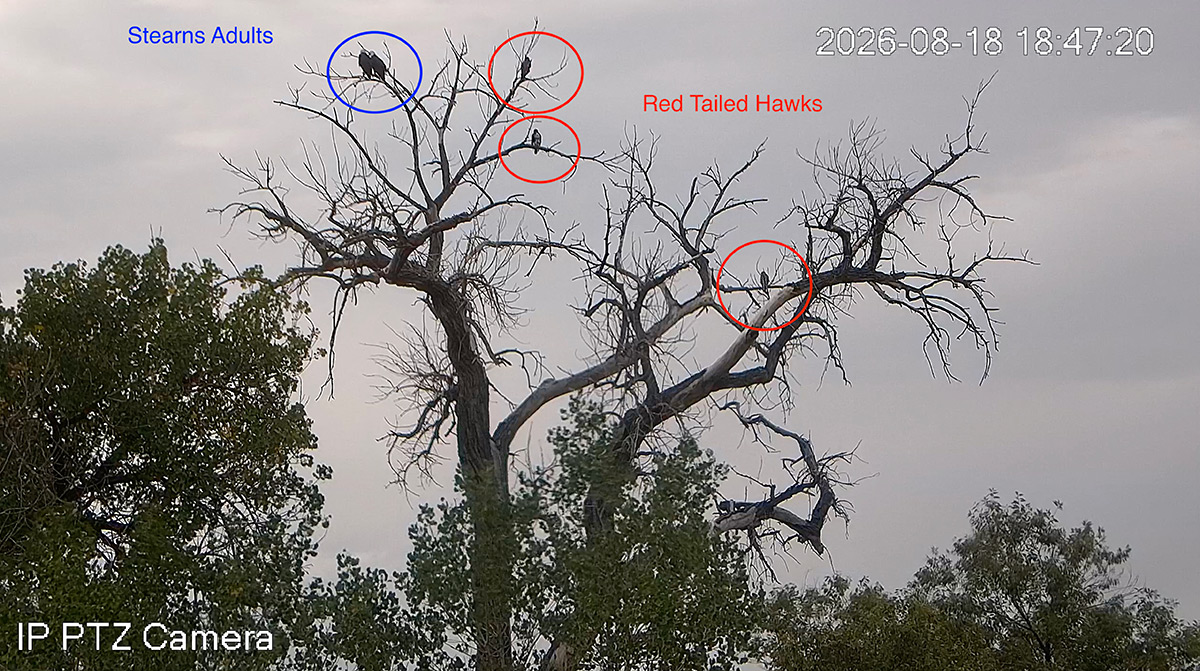
Both adult Stearns Bald Eagles at the top of the “Owl” perch tree with three Red-tailed Hawks sharing the tree.
A Late-Summer Truce?
We don’t know that “truce” is the right biological word, but it is a useful description of what we saw.
Neither species simply surrendered the area to the other. Both continued using Nest C and Owl, only about 100 m apart, while the other species was present. Individuals of both species moved between the two trees during the observation period, yet rather than repeatedly spending energy driving one another away, they appeared to accommodate one another at remarkably close distances.
There may even have been a subtle form of territoriality occurring. Individuals often maintained small vertical or lateral distances from one another. They watched one another and occasionally responded to movements, but those interactions did not escalate into the aggressive encounters these species are quite capable of having.
The timing may help explain it.
The two Stearns Bald Eagle juveniles have now dispersed. The adult eagles therefore no longer have dependent young in the territory to defend. The Red-tailed Hawks appear to be at a different stage, with at least two juveniles of the year still using this immediate area during their post-fledging period.
For the eagles, there may simply be little benefit in spending energy excluding familiar Red-tailed Hawks from trees they all use. For the likely adult RTHAs, attacking two adult Bald Eagles that are behaving predictably and presenting no obvious threat to their juveniles could carry considerably more cost than benefit.
Perhaps most interesting is that these birds are not necessarily strangers. Bald Eagles and Red-tailed Hawks have occupied this same landscape for years, including some of the same trees.
What we observed from August 11–18 may therefore be a glimpse of something much subtler than either conflict or friendship: two neighboring species continuing to occupy overlapping space while apparently recognizing that, at this particular stage of their breeding cycles, neither has much to gain from a fight.
We will continue watching.